How to build a vertical short-drama streaming app like DramaBox
October 2026
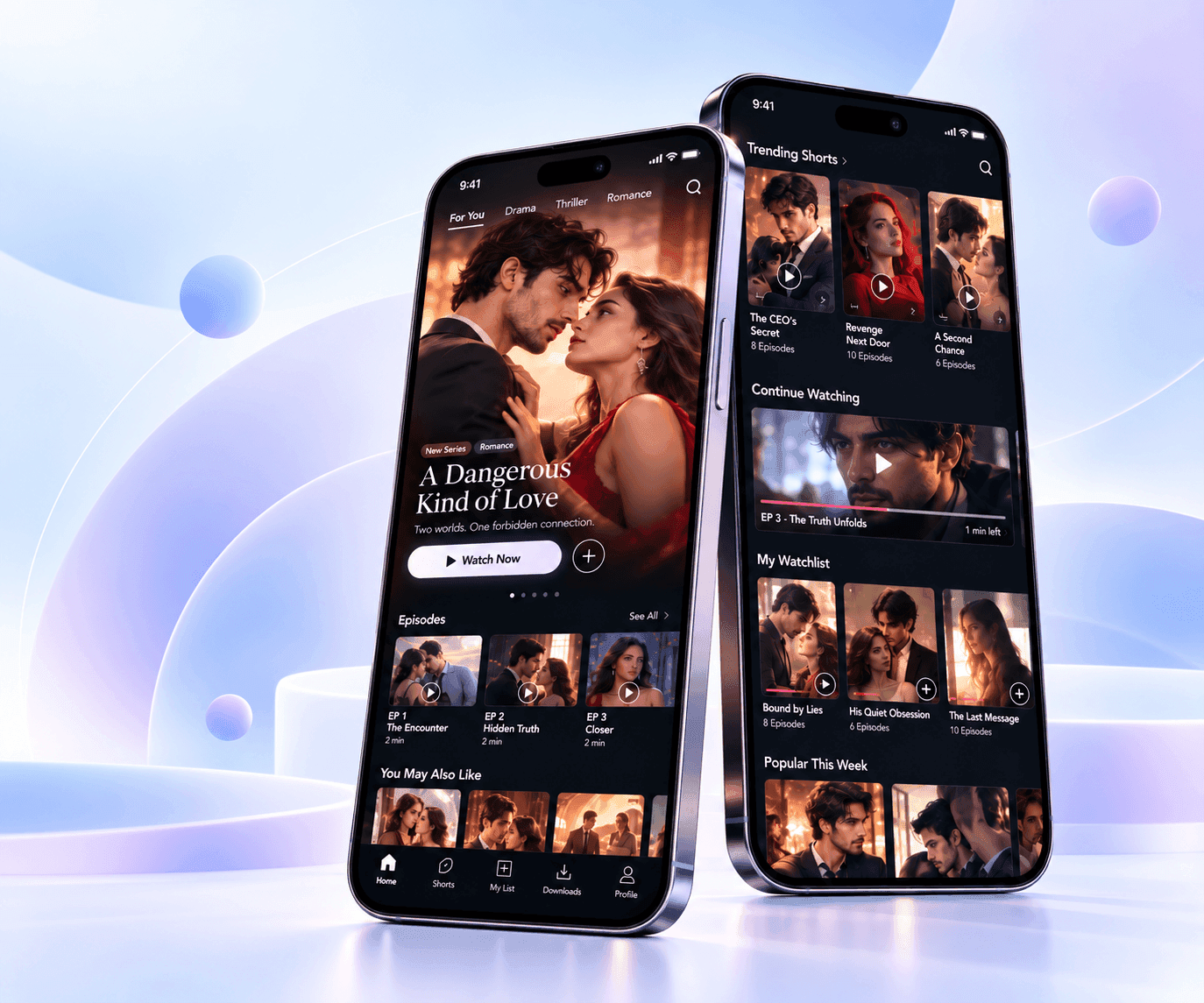
Vertical short drama is the first video format in a decade to arrive fully formed on mobile rather than being adapted to it. Apps like DramaBox and ReelShort serve episodes of sixty to ninety seconds, shot 9:16, in series that run to a hundred parts — and they monetize them one episode at a time rather than once a month.
That combination is what makes it interesting commercially, and what makes it a genuinely different build. A micro-drama app is not a video-on-demand service with a vertical player bolted on. The catalogue model, the payment mechanic, the recommendation loop and the retention problem are all different.
This guide covers what the format actually is, what drives it, how to build the app, and the monetization models that pay for the content. Innocrux ships this stack as a white-label OTT platform, so the last section covers what you would and would not have to build yourself.
Why micro-dramas work
A micro-drama episode runs one to three minutes. A series runs sixty to a hundred episodes. The whole arc is roughly the length of a feature film, cut into pieces small enough to watch in a lift.
That shape matters more than it sounds. It means a viewer never has to decide whether to commit an evening — only whether to watch one more minute, which is a decision the format asks them to make again every sixty seconds. The cliffhanger is not a stylistic flourish; it is the business model.
It also means production economics invert. A conventional drama spends heavily on a small number of hours. A micro-drama series spends lightly across many short episodes, shot fast on a single location with a small cast. That lets a platform test a premise cheaply, kill what does not land, and commission more of what does — the same logic that made short-form social video work, applied to scripted storytelling.
The market, without the hype
Most coverage of this format leads with a revenue figure. We are leaving those out, because the ones in circulation are rarely sourced and a number you cannot defend is worse than no number in a pitch deck.
The structural case is stronger anyway. Vertical short drama grew first in China, where the production pipeline and the in-app payment habit both already existed, and has since moved into North America, Southeast Asia and the Gulf. The pattern in each market is the same: a local-language catalogue, a coin wallet, and acquisition through the same short-video platforms the format imitates.
What that means for an operator is that the opportunity is not "build the next DramaBox globally". It is a language, a region or a genre that the incumbents have not localized properly — which is a far more reachable target, and one where a white-label platform rather than a from-scratch build is the difference between launching this quarter and next year.
The apps setting the format
A handful of apps have established what audiences now expect. Knowing what each does well is the fastest way to scope your own build.
- DramaBox — the reference point for pacing. Romance, revenge and fantasy series built around cliffhangers, with an unlock prompt placed exactly where the story hurts most. Its interface is the one most users will compare yours against.
- ReelShort — strongest on international genre experimentation and on recommendation. It proved the format travels outside China, and that Western audiences will pay per episode.
- Kuaishou — a short-video platform that added micro-drama rather than the reverse, which gives it distribution most standalone apps cannot match. The lesson is that acquisition and the catalogue are the same problem.
- GoodShort — built on localization. Regional languages and culturally specific storytelling, which is the gap most global apps leave open.
- Amazon MiniTV — short-form inside an app people already have. A reminder that bundling is a competing strategy to standalone.
The common thread is not the content. It is that all of them pair a swipe-native player with a payment mechanic that charges in units small enough to feel free.
What is driving the trend
Viewing has fragmented, not shrunk
People did not stop watching long content. They acquired a second mode — short sessions, several times a day, on a phone held vertically. Micro-drama is scripted storytelling designed for that second mode rather than squeezed into it.
The format is native to the device
9:16 full-bleed, no letterboxing, no rotation, no chrome. The frame is composed for a phone, which means faces are large, text is legible without zooming, and the first shot reads instantly. A landscape show cropped to vertical never looks like this.
Emotional payoff arrives fast
The format trades nuance for velocity. A betrayal lands in ninety seconds. That is a legitimate storytelling constraint, and writers who understand it produce something audiences finish rather than abandon.
Localization is cheap now
AI dubbing and subtitling have moved a series into a new language from a months-long vendor project to an overnight job. For a format whose economics depend on volume, that changes which markets are worth entering.
Acquisition and content share a channel
The same vertical clips that make the catalogue make the ads. A platform can cut a trailer from an episode and run it on the social feeds where its audience already is, which keeps acquisition cost tied to content cost rather than to media buying.
How to build one, step by step
1. Pick a niche narrow enough to win
The failure mode is launching a general-purpose short-drama app against incumbents with thousands of titles. Pick a language, a region or a genre and own it. A Tamil-language romance catalogue or an Arabic thriller slate is a defensible position; "short dramas" is not.
2. Decide what you are building versus buying
The parts specific to your business are the catalogue, the pricing and the brand. The parts that are not are transcoding, packaging, DRM, the player, the wallet, the storefront and the apps. Building the second group from scratch is a year of engineering before the first episode streams, which is why most operators start on a platform that already runs ingest, delivery and apps.
3. Design the wallet before the player
This is the step most teams take last and should take first. How many coins does an episode cost? How many coins are in the smallest bundle? How many free episodes before the first paywall? Those three numbers determine your revenue per viewer, and changing them after launch means repricing a catalogue people have already bought into.

4. Build for the first eight seconds
Retention in this format is decided twice: when the first frame loads, and at every episode boundary. That makes start-up latency, next-episode preloading and autoplay engineering problems with a direct revenue consequence. An app that stalls for two seconds between episodes loses viewers mid-series, and those viewers had already paid.
5. Launch into a channel, not into a store
Publishing to the App Store and Play Store is distribution, not acquisition. Plan the vertical clips, the creator partnerships and the paid social from the same production that makes the episodes, because the format's whole advantage is that its content and its advertising are the same asset.
How to monetize micro-dramas
Most micro-drama revenue is transactional, not subscription. That is the single biggest difference from a VOD service, and it shapes the product — including what you pay to run it, since billing per transaction and billing per subscriber scale differently.
Episode unlocks and coin wallets
The dominant model. Viewers buy coins in bundles and spend them to unlock the next episode. It works because each decision is small, the price is abstracted from real currency, and the prompt arrives at a moment of maximum narrative pressure. It also means your revenue scales with episodes watched rather than with months retained.
Ad-reward unlocks
Let viewers earn an unlock by watching an ad. This converts the audience who will never pay into inventory, and it is the on-ramp that produces paying users later. Treat it as acquisition, not as an advertising business.
Subscription, as the ceiling
A monthly pass that removes unlocks entirely captures your heaviest viewers, who would otherwise hit a spend ceiling and stop. It is rarely the primary model in this format, but it raises the top of the revenue curve.
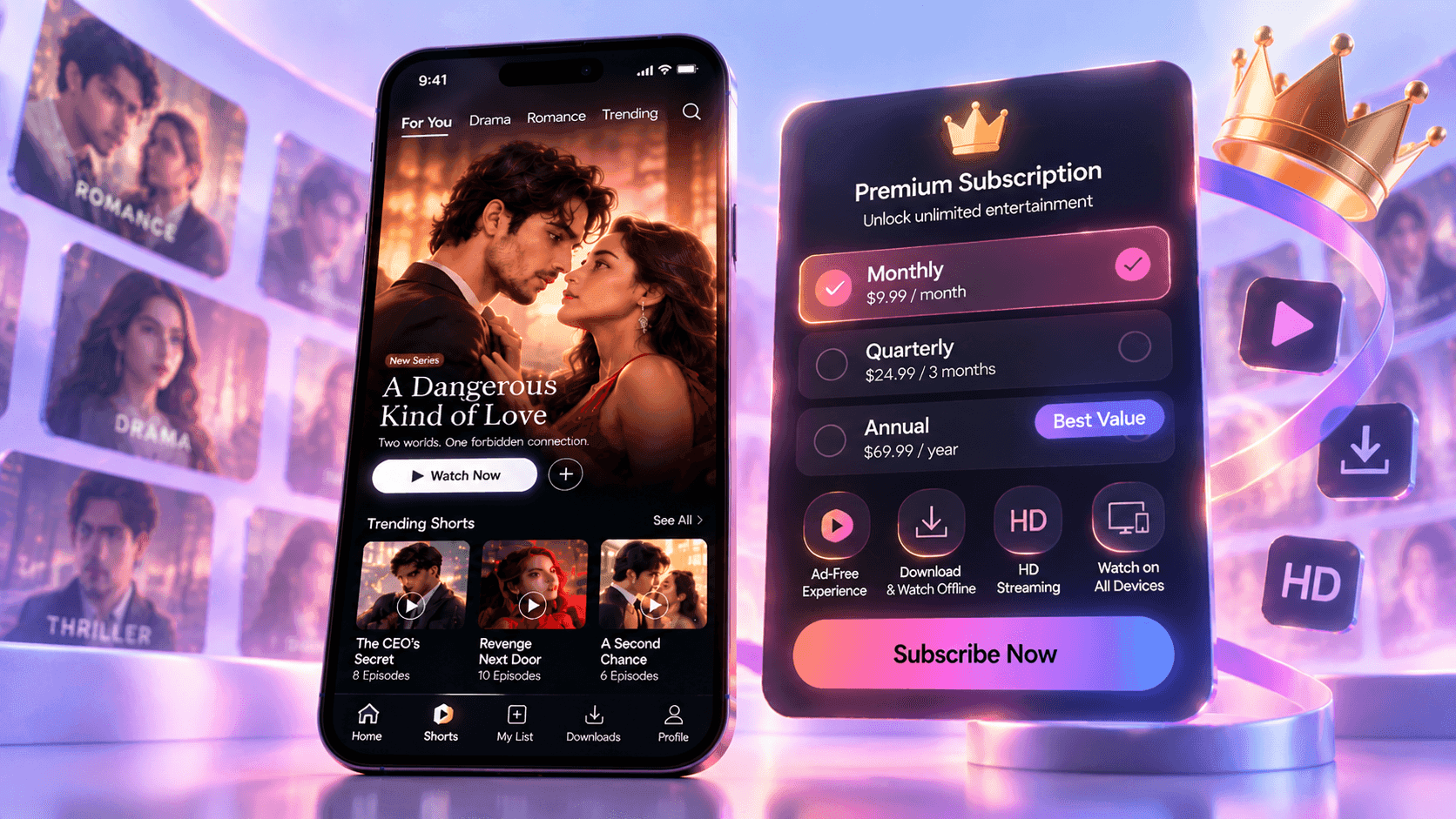
Advertising between episodes
Episode boundaries are natural ad breaks and there are a great many of them. Server-side insertion keeps the break from breaking playback, which matters more here than in long-form because the content either side is so short.
Hybrid is the normal end state
In practice a mature micro-drama app runs free episodes to hook, ad-reward unlocks to convert the unwilling, coins for the majority, and a pass for the heaviest. Each model catches an audience the others miss. The platform decision that matters is whether it can run SVOD, AVOD, TVOD and pay-per-view at once, per title and per market.
Features you cannot ship without
- A swipe-native vertical player — full-bleed 9:16, instant start, next-episode preloading, and resume that survives an app restart.
- A coin wallet and IAP — bundles, balance, transaction history, and store-compliant purchase flows on both iOS and Android.
- Episode-level entitlement — the unlock state is per episode per user, and it has to be enforced server-side or the catalogue leaks.
- Multi-DRM — Widevine, FairPlay and PlayReady. Licensors will ask, and an unprotected catalogue is republished within days of a hit.
- Recommendations tuned to short sessions — what to autoplay next matters more than a homepage rail, because most viewing is a continuous run rather than a browse.
- AI dubbing and subtitles — the mechanism for taking one series into every market you sell in without re-shooting it.
- Episode-level analytics — completion and drop-off per episode, not per title. The whole catalogue is tuned on where viewers stop.
- Offline download — commuting is a primary use case and connectivity is not guaranteed on it.
Where the format goes next
Three things look likely. Production will professionalize, as it did for mobile games, and the gap between a cheap series and a good one will widen. Localization will stop being a differentiator and become a baseline, because AI dubbing has made it cheap enough that everyone does it. And the format will stop being a separate app for some operators and become a tier inside a larger service, the way short-form video became a tab rather than a competitor.
For anyone building now, the implication is to treat the catalogue and the pricing as the durable assets, and the app as something that should be replaceable without a rebuild.
Launching on Innocrux
Innocrux ships the micro-drama stack white-label: the swipe-native vertical player, coin wallets and in-app purchase, ad-reward unlocks, episode-level entitlement, multi-DRM protection, AI dubbing across languages, and apps for iOS, Android, smart TV and web under your brand and your developer account.
What that leaves you is the part only you can do — commissioning the catalogue, setting the prices, and finding the audience. Innocrux runs the infrastructure behind it, and nothing viewer-facing carries our name.
If you are scoping a short-drama launch, talk to our engineers about the catalogue size, the markets and the monetization mix you have in mind, and we will tell you what it takes to get it live. The rest of the Innocrux platform — VOD, live, catch-up TV and the AI video suite — runs on the same stack.

Meet the authors

Kavirajan ST is CEO and co-founder of Innocrux, which builds white-label OTT platforms for broadcasters, studios and creators — video on demand, live, catch-up TV and micro-drama, with an integrated AI video suite.
Related articles
What is TVOD, and how does transactional video on demand work
November 2026
How AI is transforming OTT personalization and viewer retention
February 2026
What is OTT streaming? Benefits, solutions and where it goes next
October 2026

Building a streaming service?
Innocrux ships the OTT stack white-label — VOD, live, micro-drama, multi-DRM and an AI video suite, under your brand.