




Introduction to CDN Importance
The OTT industry is no longer just about streaming videos—it’s about building a complete digital business. In 2025, creators, broadcasters, and enterprises are focusing on how to build an OTT platform that not only delivers content but also generates consistent revenue.
With increasing competition, simply launching an OTT platform is not enough. You need a powerful OTT solution, strong monetization strategies, and a reliable content delivery infrastructure. This is where CDNs play a major role in shaping user experience and revenue growth.
If your platform buffers, users leave. If your platform performs smoothly, users stay, subscribe, and spend more. That’s why choosing the best OTT streaming solution and the right OTT solution provider becomes critical for success.
Platforms like Innocrux offer an end to end OTT solution that combines streaming performance, CDN optimization, and monetization tools—all in one place. Whether you want to build OTT apps, launch a VOD solution, or create a live streaming solution, having the right foundation is key.
What is a CDN and How It Works in OTT Platforms
A Content Delivery Network (CDN) is a system of distributed servers designed to deliver video content efficiently based on user location. Instead of relying on a single central server, CDNs cache content across multiple edge locations worldwide.
When a user accesses your OTT platform, the CDN identifies the nearest server and delivers the content from that location. This reduces the distance data travels, resulting in faster playback and minimal buffering.
For anyone exploring how to build an OTT platform from scratch, understanding CDN architecture is essential. Without it, even the best OTT video solution cannot scale effectively.
CDNs also support adaptive bitrate streaming, which automatically adjusts video quality based on the user’s internet speed. This ensures uninterrupted playback, which directly impacts engagement and monetization.
Importance of CDN for Improving Video Streaming Performance
CDNs are not just technical infrastructure—they directly influence your revenue and user retention.
Here’s how:
- Faster startup time: Users expect videos to start instantly. Even a delay of 2 seconds can increase drop-off rates significantly.
- Reduced buffering: Continuous playback keeps users engaged longer, increasing watch time and ad impressions.
- Global reach: A CDN allows your OTT platform provider to deliver content worldwide without performance issues.
- Scalability: During live events or viral content spikes, CDNs handle millions of concurrent users smoothly.
For businesses looking to build live streaming apps or deploy a video on demand solution, CDN performance is a major deciding factor in user satisfaction.

OTT Monetization Trends and Statistics in 2025
OTT monetization is evolving with user behavior and technology advancements. Understanding these trends helps you design a profitable OTT platform.
Key Statistics:
- The OTT market is projected to exceed $450 billion globally by 2025
- Hybrid monetization models are used by over 70% of OTT platforms
- Platforms using advanced CDN optimization report 35% lower churn rates
- Live streaming monetization is growing 2x faster than traditional VOD
- Ad-supported streaming (AVOD) is expected to grow by 25% annually
What This Means for You:
If you’re planning to build OTT platform solutions or exploring OTT solution providers in India, you need to combine monetization strategies with performance optimization.
A slow platform reduces ad impressions, subscription renewals, and overall revenue. A fast platform powered by a strong CDN increases engagement and monetization opportunities.
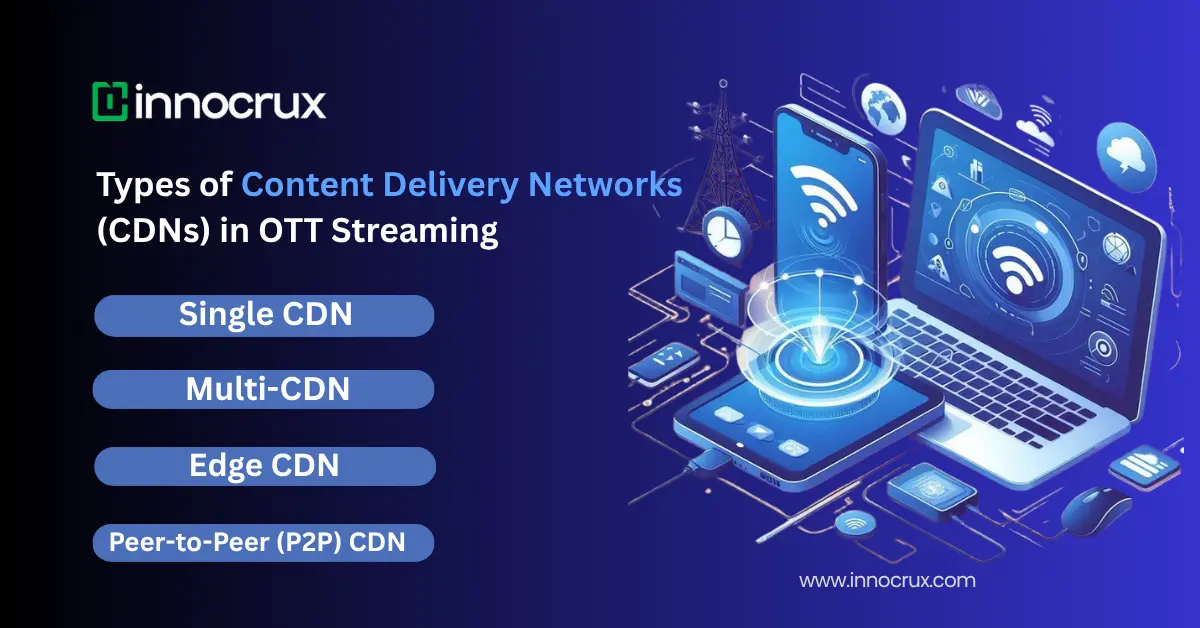
Types of CDNs Used in OTT Video Streaming Platforms
1. Single CDN in OTT Platforms
A single CDN setup uses one provider to deliver all your content.
This approach is often used by startups or businesses testing the OTT market. It is simple to implement and requires minimal technical management.
However, relying on a single CDN can become risky as your platform grows. If the CDN experiences downtime or performance issues, your entire streaming service is affected.
For those starting with a basic VOD platform provider, this can be a good entry point, but scaling requires moving to more advanced CDN strategies.
2. Multi-CDN Strategy for Better Reliability
A multi-CDN strategy distributes traffic across multiple CDN providers. This ensures that if one network fails, another can take over seamlessly.
This setup is widely used by large OTT platform providers and enterprises delivering global content.
Benefits include improved uptime, better performance across regions, and optimized traffic routing. It also allows platforms to select the best-performing CDN in real time.
If you’re building a high-performance OTT streaming solution or targeting global audiences, multi-CDN is essential.
3. Peer-to-Peer (P2P) CDN
P2P CDN leverages users’ devices to share content with other viewers. Instead of relying entirely on centralized servers, viewers contribute bandwidth.
This approach significantly reduces delivery costs and improves scalability during peak traffic events.
It is particularly useful for live streaming solutions like sports events, concerts, and webinars where thousands of users access content simultaneously.
However, P2P CDN works best when combined with traditional CDN infrastructure to ensure reliability and quality.
4. Edge CDN for Low Latency
Edge CDNs bring content closer to users by storing data at edge servers located near end-users.
This is crucial for real-time applications such as live streaming apps, gaming, and interactive OTT platforms.
Edge CDN reduces latency, improves video quality, and ensures instant playback. It is a must-have for platforms aiming to deliver premium user experiences.
If you’re planning to build a live streaming platform or a live video streaming web application, edge CDN should be part of your core infrastructure.
| CDN Type | Description | Best Use Case in OTT Platforms | Key Advantages | Limitations |
| Single CDN | Uses one CDN provider to deliver all OTT video content | Startups, small OTT platforms, basic video on demand solution | Easy setup, lower cost, simple management | Risk of downtime, limited scalability, performance issues in some regions |
| Multi-CDN | Uses multiple CDN providers to distribute traffic dynamically | Large-scale OTT platforms, global OTT streaming solution | High reliability, better performance, failover support | Higher cost, complex management |
| Peer-to-Peer (P2P) CDN | Uses user devices to share bandwidth and distribute content | Live streaming platforms, sports events, high concurrent viewers | Reduces bandwidth cost, improves scalability | Depends on user network quality, less control over delivery |
| Edge CDN | Stores and delivers content from servers closest to end users | Low-latency streaming, live video streaming solution, real-time OTT apps | Faster delivery, reduced latency, improved user experience | Requires advanced infrastructure, higher setup complexity |
Choosing the Right CDN Strategy for OTT Platforms
Selecting the right CDN strategy depends on your business goals and audience.
Here are some key considerations:
- Audience location: Global platforms need multi-CDN
- Content type: Live streaming requires low latency solutions
- Traffic volume: High traffic demands scalable CDN architecture
- Monetization model: Ad-based platforms require smooth playback for better ad delivery
For example, a startup focusing on how to build a VOD platform may start with a single CDN, while an enterprise offering IPTV OTT solutions will require multi-CDN with edge optimization.
How Innocrux Improves CDN Performance
Innocrux stands out as a leading OTT solution provider by integrating advanced CDN technologies into its platform.
Advanced Features Include:
- Intelligent CDN switching for best performance
- Multi-CDN architecture for reliability
- Real-time analytics for monitoring streaming quality
- AI-based optimization for traffic routing
- Seamless integration with live streaming and VOD platforms
Whether you want to build OTT apps, create a white label OTT solution, or develop a custom OTT solution development project, Innocrux ensures high-quality streaming delivery.
Future of OTT Monetization and CDN in 2025
The future of OTT will be driven by:
- AI-powered content recommendations
- Advanced CDN optimization
- Interactive and immersive streaming
- 5G-enabled ultra-fast delivery
Businesses that invest in both technology and monetization strategies will lead the OTT market.
Conclusion
OTT success in 2025 depends on a combination of performance, scalability, and monetization.
To succeed, you need:
- A powerful OTT streaming solution
- A scalable CDN strategy
- A flexible monetization model
- A trusted OTT solution provider like Innocrux
Whether you’re planning to build OTT apps, launch a VOD solution, or create a live streaming platform, focusing on both CDN performance will ensure long-term growth and profitability.


No comments yet