




1. Introduction to OTT Streaming Architectures
OTT (Over-The-Top) streaming has completely changed the way audiences consume content today. From binge-watching series to live sports and short-form videos, users expect seamless, high-quality streaming across devices. This experience is made possible by a strong and well-planned OTT streaming architecture.
1.1 What is OTT Streaming Architecture?
OTT streaming architecture is the backbone of any streaming platform. It includes all the technical components involved in video ingestion, encoding, storage, content delivery, and playback. This architecture ensures that content reaches users efficiently, regardless of their location or device.
It typically involves cloud servers, CDNs, encoding pipelines, APIs, and playback systems working together to deliver a smooth experience.
1.2 Importance of Choosing the Right Architecture
Choosing the right architecture is critical because it directly affects performance, scalability, and cost. A poorly designed system can lead to buffering, downtime, and poor user retention.
A strong architecture helps in:
- Delivering high-quality video without interruptions
- Scaling during peak traffic (like live events)
- Reducing latency and improving load times
- Ensuring security and content protection
Ultimately, the right architecture supports long-term business growth and user satisfaction.
2. What are the Types of OTT Streaming Architectures?
OTT platforms rely on different architectures depending on their business model, audience size, and technical requirements. No single architecture fits all use cases, which is why understanding each type is important.
2.1 Overview of Architecture Types
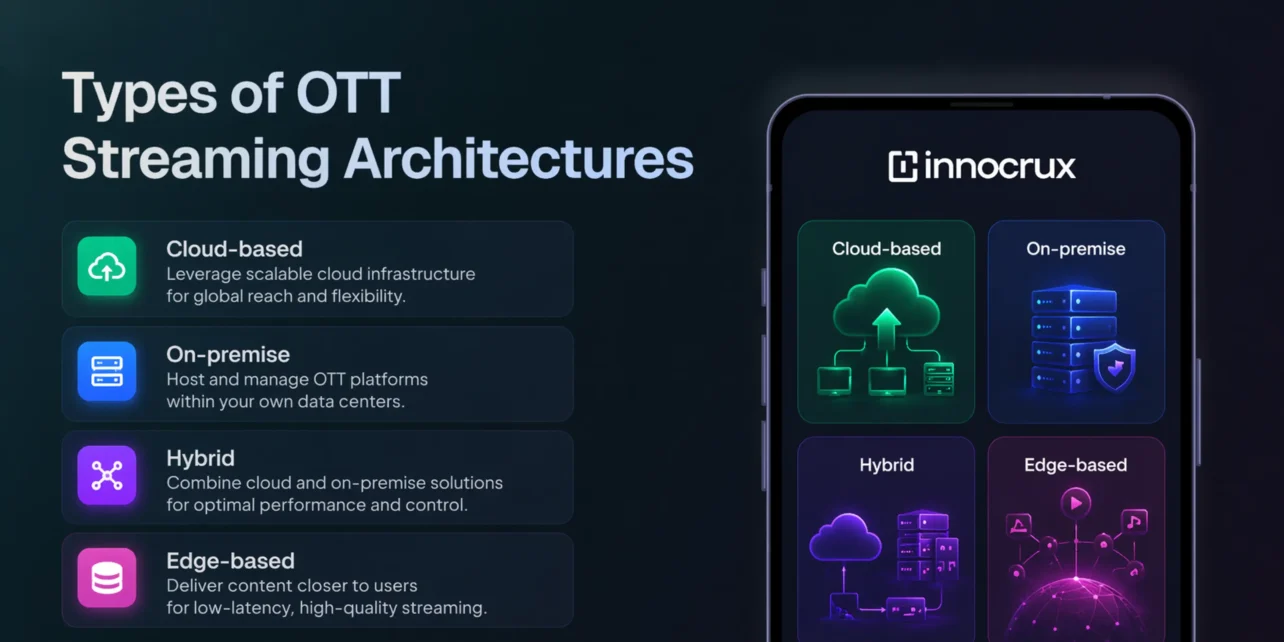
The four main OTT streaming architectures are:
- Cloud-based architecture – Flexible and scalable
- On-premise architecture – Full control and customization
- Hybrid architecture – Combination of cloud and on-premise
- Edge-based architecture – Optimized for speed and low latency
Each architecture serves different needs, from startups to large-scale enterprises.
2.2 Key Differences Between Architectures
The main differences lie in:
- Deployment: Cloud vs physical infrastructure
- Cost: Pay-as-you-go vs upfront investment
- Scalability: Dynamic vs limited expansion
- Control: Managed vs fully owned systems
Understanding these differences helps businesses choose an architecture aligned with their goals.
3. Types of OTT Streaming Architectures Explained
3.1 Cloud-Based Architecture
3.1.1 What is Cloud-Based OTT Architecture?
Cloud-based OTT architecture uses cloud platforms to manage video processing, storage, and delivery. Instead of maintaining physical servers, everything is hosted in the cloud.
This allows OTT solution providers to launch and scale quickly without worrying about infrastructure management.
3.1.2 Key Features and Benefits
- Auto scalability to handle sudden traffic spikes
- Cost efficiency with pay-as-you-use pricing
- Global reach through integrated CDNs
- Easy maintenance with automatic updates
It also supports integration with analytics, AI recommendations, and monetization tools.
3.1.3 Use Cases
- Startups launching new OTT platforms
- Businesses with unpredictable traffic
- Platforms targeting global audiences
- Live streaming platforms with dynamic demand
3.2 On-Premise Architecture
3.2.1 What is On-Premise OTT Architecture?
On-premise architecture involves hosting all streaming infrastructure within a company’s own data center. This includes servers, storage systems, and networking equipment.
It gives full ownership and control over the entire streaming environment.
3.2.2 Advantages and Limitations
Advantages:
- Complete control over data and systems
- High level of customization
- Better compliance with strict regulations
- Enhanced data privacy
Limitations:
- High initial investment in hardware and setup
- Ongoing maintenance and operational costs
- Limited scalability during peak demand
- Requires skilled IT teams
3.2.3 Use Cases
- Government or regulated industries
- Enterprises handling sensitive data
- Organizations requiring strict compliance
- Platforms with predictable traffic
3.3 Hybrid Architecture
3.3.1 What is Hybrid OTT Architecture?
Hybrid architecture combines both cloud and on-premise environments. It allows businesses to distribute workloads between the two systems.
This approach provides flexibility while maintaining control over critical operations.
3.3.2 Combining Cloud and On-Premise
For example:
- Sensitive data can be stored on-premise
- Content delivery and scaling can be handled via cloud
This ensures both security and performance.
3.3.3 Benefits and Flexibility
- Balanced cost and performance
- High scalability with controlled infrastructure
- Improved disaster recovery and backup
- Flexibility to shift workloads as needed
Hybrid architecture is often considered the most practical solution for growing OTT platforms.
3.4 Edge-Based Architecture
3.4.1 What is Edge-Based Streaming?
Edge-based architecture focuses on delivering content from servers located closer to the user. Instead of sending data from a central server, it uses distributed edge nodes.
3.4.2 Role of CDNs and Edge Servers
Content Delivery Networks (CDNs) play a key role by caching content across multiple geographic locations. When a user requests a video, it is delivered from the nearest edge server.
3.4.3 Benefits for Low Latency Streaming
- Faster video loading times
- Reduced buffering and interruptions
- Improved streaming quality
- Ideal for live events and real-time content
Edge-based architecture is essential for platforms targeting global audiences with high performance expectations.
4. Comparison of OTT Streaming Architectures
4.1 Performance Comparison
Edge-based and cloud architectures provide superior performance due to distributed infrastructure. On-premise setups may struggle during high traffic unless heavily optimized.
4.2 Cost Considerations
- Cloud: Low upfront cost, flexible pricing
- On-premise: High initial investment
- Hybrid: Balanced cost approach
- Edge: Additional cost but improved performance
Choosing the right model depends on budget and long-term goals.
4.3 Scalability and Flexibility
Cloud and hybrid architectures offer the highest scalability, allowing platforms to grow without major infrastructure changes.
5. How to Choose the Right OTT Architecture
5.1 Factors to Consider
When selecting an architecture, consider:
- Audience size and geographic distribution
- Type of content (live vs on-demand)
- Budget and operational costs
- Required level of control and security
- Expected growth and scalability
5.2 Business and Technical Requirements
A small startup may benefit from cloud architecture, while large enterprises may prefer hybrid or on-premise solutions. Aligning technical decisions with business goals is key to success.
6. How Innocrux Helps with OTT Architecture
Innocrux offers end-to-end OTT solutions designed to meet modern streaming demands. Their approach focuses on performance, scalability, and reliability.
6.1 Scalable Cloud Solutions
Provides flexible infrastructure that grows with your audience, ensuring uninterrupted streaming.
6.2 Hybrid Deployment Options
Allows businesses to combine cloud and on-premise environments for better control and efficiency.
6.3 Optimized Streaming Performance
Delivers high-quality video with low latency using advanced CDNs and edge technologies.
6.4 End-to-End Support
From platform setup to optimization, Innocrux supports OTT providers at every stage.
7. Conclusion
OTT streaming architecture is the foundation of a successful streaming platform. It determines how efficiently content is delivered, how well the platform scales, and how users experience the service.
Each architecture—cloud-based, on-premise, hybrid, and edge-based—has its own strengths and ideal use cases. Businesses must evaluate their needs carefully before choosing the right approach.
As the OTT industry continues to evolve, adopting advanced, scalable, and flexible architectures will be essential. Platforms that invest in the right infrastructure today will be better positioned to deliver high-quality streaming experiences and achieve long-term growth.


No comments yet